
 (905) 906-7546
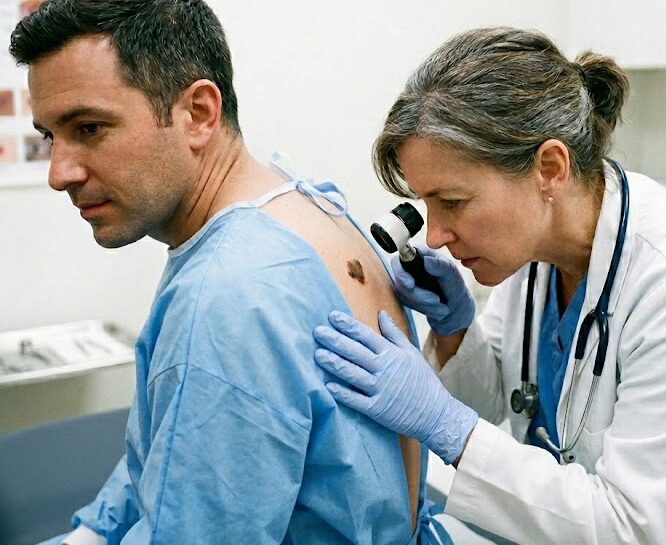
The arrival of May brings more than just warmer weather to Southern Ontario; it marks Skin Cancer Awareness Month. For many of us, this is the time of year when we trade our heavy coats for t-shirts and start spending more time outdoors. However, as we expose more skin to the sun, we often start noticing spots, bumps, or moles that haven’t been on our radar all winter.
It is completely natural to feel a bit of anxiety when you spot a new mark on your arm or notice an old mole looks slightly different than it did last year. You might find yourself leaning into the bathroom mirror, wondering if that spot is just a “beauty mark” or something that requires professional attention.
At Mole Institute, we believe that peace of mind comes from clarity. Understanding the physical differences in the melanoma vs. benign mole comparison is the first step in a proactive health journey. Our goal is to move beyond casual observation and toward a sophisticated system of professional monitoring that saves lives.
Key Takeaways
- Benign Moles are typically symmetrical, have smooth borders, and remain stable over time.
- Melanoma often presents with irregular shapes, varied colours, and noticeable growth.
- The ABCDE Rule is a vital self-examination tool, but it does not replace professional mapping.
- Early Detection is the most effective way to manage skin cancer risks.
- Professional Monitoring provides a baseline that allows for the detection of “micro-changes” invisible to the naked eye.
Understanding the Common Benign Mole
Most adults have between 10 and 40 moles on their body. In the vast majority of cases, these are perfectly harmless clusters of pigmented cells called melanocytes. A typical benign mole usually appears in childhood or adolescence and stays relatively the same for decades.
Characteristics of a Healthy Mole
A “normal” or benign mole generally follows a predictable pattern:
- Symmetry: If you were to draw a line through the middle, both halves would look roughly the same.
- Defined Borders: The edges are clear and distinct from the surrounding skin.
- Uniform Colour: It is usually one solid shade of brown, tan, or black.
- Small Diameter: Most benign moles are smaller than 6 mm (about the size of a pencil eraser).
While these spots are stable, they aren’t completely “set in stone.” They may get slightly darker with sun exposure or during life changes, but they should never show rapid or erratic shifts in appearance.
What is Melanoma?
Melanoma is a type of skin cancer that develops when melanocytes begin to grow out of control. While it is less common than other types of skin cancer, it is significantly more dangerous because it has a higher likelihood of spreading to other parts of the body if not caught early.
According to the Canadian Cancer Society, melanoma is one of the most preventable types of cancer, yet its incidence rates have been rising among Canadians over the last several decades. This is why shifting our mindset from “watching and waiting” to “active monitoring” is so critical.
The ABCDEs of Melanoma vs. Benign Moles
To help distinguish between a harmless spot and a potential risk, experts developed the ABCDE acronym. This serves as a primary checklist for anyone performing a self-check at home.
A is for Asymmetry
As mentioned, benign moles are round and even. Melanoma is often asymmetrical. If you imagine folding the mole in half and the sides don’t match, that is a red flag that requires a professional look.
B is for Border
Healthy moles have smooth, even borders. The borders of an early melanoma may be ragged, notched, or blurred. The pigment might also appear to “leak” into the surrounding skin.
C is for Colour
A benign mole is usually a single shade of brown. Melanomas often feature a “mottled” appearance with several different shades. You might see a mix of tan, dark brown, black, or even splashes of red, white, and blue.
D is for Diameter
While melanomas can be small, they are often larger than 6 mm. If you have a spot that is larger than the eraser on a wooden pencil, it deserves a spot on your professional monitoring list.
E is for Evolving
This is arguably the most important factor. A benign mole stays the same. A melanoma changes. Whether it’s changing in size, shape, colour, or height, or if it starts to itch, bleed, or crust, evolution is a signal from your body that something is happening beneath the surface.
Why “Just Looking” Isn’t Enough
While the ABCDE rule is helpful, it has limitations. Some melanomas don’t follow these rules perfectly. For example, “amelanotic” melanomas lack pigment and can look like a pinkish bump or a harmless scar.
This is where the difference between observation and detection becomes clear. Detection involves high-resolution imaging and tracking. Much like how you wouldn’t just “listen” to your car engine to diagnose a complex timing belt issue, you shouldn’t rely solely on a quick glance in a dim bathroom mirror to assess your skin health.
Professional monitoring at Mole Institute involves creating a digital map of your skin. This allows us to compare images over time with mathematical precision. We can see if a mole has expanded by even a fraction of a millimetre—a change that is nearly impossible for a person to remember or see on their own.
Who is at High Risk?
While anyone can develop skin cancer, certain factors increase the necessity for a personalized monitoring plan:
- High Mole Count: Having more than 50 common moles.
- Family History: A first-degree relative who has had melanoma.
- Sun History: A history of blistering sunburns, especially during childhood.
- Skin Type: Fair skin that freckles or burns easily.
- Immune Status: Those with suppressed immune systems.
For residents in areas like Burlington and Oakville, where many enjoy an active outdoor lifestyle on the water, being mindful of these risks is a part of responsible community health.
Creating Your Personalized Monitoring Schedule
Prevention isn’t a one-size-fits-all solution. A teenager with two moles requires a different approach than a 50-year-old with a history of sun damage.
At Mole Institute, we focus on specialized skin health services that cater to your specific risk profile. We look at your history, your skin type, and your current “mole map” to determine how often you should be seen. For some, an annual check is perfect; for others, a six-month interval ensures that no change goes unnoticed.
Taking Action This May
Skin Cancer Awareness Month is the perfect time to commit to a higher standard of care. We often take care of our homes in Brantford, our businesses in Ancaster, and our community projects in Stoney Creek with great detail. Your skin—the largest organ in your body—deserves that same level of meticulous attention.
By choosing professional monitoring, you aren’t being alarmist; you are being intelligent. You are ensuring that if a “benign mole” ever decides to change its character, you are ready to catch it before it becomes a life-altering problem.
Reliable Resources for Further Reading
- Melanoma Network of Canada – Support and advocacy for patients.
- Canadian Dermatology Association – Expert information on skin conditions.
- Public Health Agency of Canada – National health guidelines and statistics.
- World Health Organization – Global perspective on UV radiation and skin health.
- Save Your Skin Foundation – Canadian resources for skin cancer education.
Conclusion: Detection is Peace of Mind
The journey from “melanoma vs. benign mole” doesn’t have to be a scary one. When you have a team of experts and the right technology on your side, those spots on your skin become data points in a well-managed health plan rather than sources of mystery.
Don’t wait for a spot to become a concern. Start your monitoring journey today and enjoy your summer with the confidence that your skin health is being handled with the highest level of integrity and clinical passion.
Ready to get a professional baseline? Contact Mole Institute today to schedule your personalized skin assessment.