
 (905) 906-7546
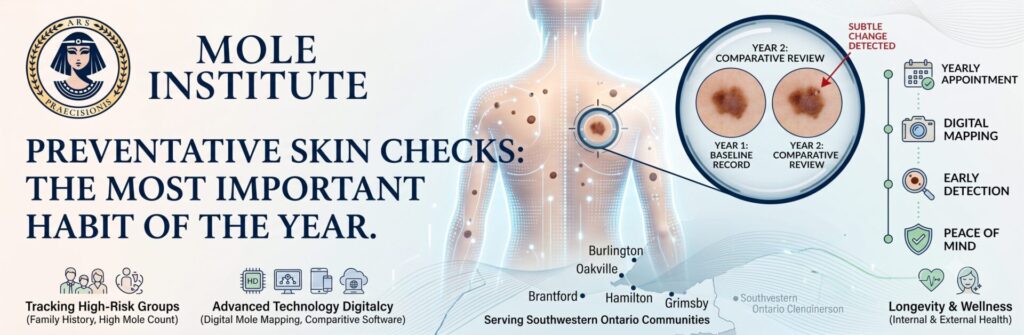
Modern Mole Mapping: Precision for Preventative Skin Health
In our region of Southern Ontario, we cherish the sun, from lakeside summers to sunny winter days. While we value that outdoor time, Canadians are also becoming much more proactive about long-term well-being. People often ask, “How do I take care of my skin for life?” The old answer was a simple visual check in the bathroom mirror. The new, clinically robust answer involves moving beyond mere observation and embracing advanced, professional monitoring for preventative skin health.
This transformation from self-examination to sophisticated early detection is a pillar of personalized wellness. Understanding the real state of your skin, especially if you have high-risk factors like many moles, fair complexion, or a personal history of significant sun exposure, requires precise science, not subjective guessing. This article explores how a systematic approach to professional mole mapping provides the deepest level of security and foresight.
Key Takeaways
- Casual self-observation is no longer enough to manage long-term skin health; professional monitoring is the new wellness standard.
- Systematic detection with digital mole mapping catches subtle changes long before they are visible to the naked eye.
- High-risk groups (many moles, history of sunburns, immunosuppression) benefit most from specialized, annual surveillance.
- Your customized monitoring schedule provides a detailed, historical blueprint for early intervention and complete peace of mind.
- Advanced digital technology replaces memory with scientific accuracy, giving residents across regional communities a proactive long-term wellness strategy.
Moving Beyond Observation to Systematic Detection
For decades, we’ve been told that sunscreen is our primary skin defence, and it absolutely is essential for daily protection. Sunscreen prevents cumulative UV damage from your beach days or walks along the waterfront in communities like Oakville or Burlington. However, sunscreen cannot erase your history, nor can it provide a baseline of your current skin state. It is not an accurate monitoring tool.
This is where the concept of “Detection, Not Just Observation” becomes a critical wellness choice. While you might try to spot a dynamic new mole at home, subtle cellular changes frequently happen with zero physical sensation or obvious visual alarm. Professional evaluations utilize sophisticated digital technology to objectively document every square centimetre of your body. These images are captured with high-resolution dermoscopy tools, creating a historical record—a digital blueprint of your skin.
By mapping every spot, from large birthmarks to fine, millimetre-scale changes, clinical teams establish a non-biased, microscopic baseline. A regular visual check-in might tell you a mole is still there, but professional mapping tells you if it has changed, making early detection possible at a stage where a simple biopsy is often the single cure. Organizations like the Canadian Dermatology Association emphasize that consistent, professional examinations are the most reliable strategy for the early identification of potentially atypical features.
Personalized Planning: A Monitoring Schedule for Your Risks
No two people have the same risk profile. Developing a personalized plan for surveillance is just as important as getting your annual physical or managing other chronic health risks. Factors such as genetic background, skin type, family history, and occupational or recreational sun exposure play a significant role in determining how often you should have your skin mapped. This tailored approach is far from reactionary; it is a thoughtful, proactive investment in your long-term health.
A high mole density (typically defined as more than 50 significant spots) significantly increases baseline risk. Individuals in these high-risk categories, as noted by the Public Health Agency of Canada (PHAC), should prioritize systematic monitoring that is more frequent than casual observation allows. Similarly, immunosuppression due to medication or illness requires a vigilant clinical eye. Organizations like the Melanoma Network of Canada continuously remind us that understanding your unique risk and having a plan are the most effective preventive actions you can take.
During subsequent annual visits, new high-definition images are cross-referenced with your initial baseline record. Advanced comparison software is used to highlight any new spots, shifting borders, or minute changes in pigmentation. Your personalized plan doesn’t just look for problems; it looks for change—the single most important early warning signal.
A Canadian Approach to Long-Term Wellness
Embracing this proactive stance fits perfectly into the Canadian ethos of comprehensive wellness and preventative healthcare. It is about understanding that your skin is your body’s largest organ, and its health is fundamental. This comprehensive surveillance provides residents throughout Southwestern Ontario, in vibrant communities like Brantford, Hamilton, Stoney Creek, and Ancaster, with a local solution for an important aspect of longevity and total well-being.
Your wellness strategy should always align with your goals for active living. Making this advanced specialized screening a consistent, yearly appointment ensures that you are truly safe, not just assuming you are, allowing you to enjoy your local outdoor lifestyle with complete confidence and peace of mind.
Taking control of your dermal health is a powerful choice. By moving beyond simple visual check-ins and embracing sophisticated professional mole mapping, you can effectively safeguard your health and stay ahead of unexpected changes for decades to come.
Explore how our detailed Mole Institute Services can form the foundation of your personalized preventative health plan. It’s time to go beyond observation and commit to a sophisticated system of clinical monitoring.