
 (905) 906-7546

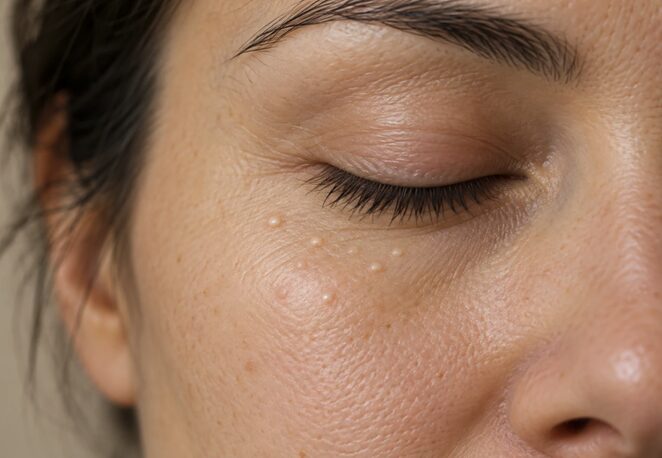
Ever noticed a tiny, pearly white bump near your eye that just won’t go away? You try to squeeze it and nothing happens. You wait a few weeks, and it’s still there. Chances are, you’ve met milia.The good news is that milia are harmless and very common, and a physician can remove them
So, what exactly are milia?
Milia are little cysts, usually just 1 to 2 millimetres across, that sit right under the surface of your skin. They tend to show up around the eyes, on the cheeks or on the nose.
They look a lot like whiteheads, but they aren’t acne. Milia form when keratin, a protein your skin makes naturally, gets trapped beneath the surface. There’s no clogged pore and no bacteria involved, which is why squeezing doesn’t work.
Why do they show up?
A widely cited review in the Journal of the American Academy of Dermatology sorts milia into two main types1:
- Primary milia appear on their own, for no obvious reason. They’re very common in newborns and often disappear without treatment.
- Secondary milia show up after the skin has been damaged, for example by sunburn or years of sun exposure, skin resurfacing treatments, blistering skin conditions, or heavy use of steroid creams.
Please don’t squeeze them
We get it, the temptation is real. But milia are covered by a thin layer of skin, so there’s nowhere for them to come out. Picking at them, especially on the delicate skin around your eyes, can lead to infection, scarring or dark marks that last much longer than the milia ever would.
How are milia removed?
Some milia fade on their own, but in adults they can hang around for months or even years. Thankfully, there are simple options1:
- Extraction: a physician makes a tiny opening with a sterile instrument and gently lifts the milia out. It’s quick, and it’s the most common in-office treatment.
- Prescription creams: retinoids such as tretinoin can help when milia are widespread or keep coming back
What to expect at your appointment
At Mole Institute, milia removal is a short visit, and treatment can often happen the same day as your consultation.
- Consultation: a physician looks at the bumps, confirms they’re milia and asks about your health history.
- Treatment: the area is numbed, then the milia are gently removed. Most procedures take 15 to 30 minutes.
- Recovery: skip sun exposure and strenuous exercise for 24 hours. A little tenderness is normal and settles quickly.
Keeping them away
After treatment, keep the area clean, resist the urge to pick, and follow your physician’s aftercare instructions.
Ready to say goodbye to milia?
If a little bump has been bothering you, book a free consultation at Mole Institute in Hamilton. No referral is needed.
References
[1] Berk DR, Bayliss SJ. Milia: a review and classification. J Am Acad Dermatol. 2008;59(6):1050-1063. PubMed 18819726