
 (905) 906-7546
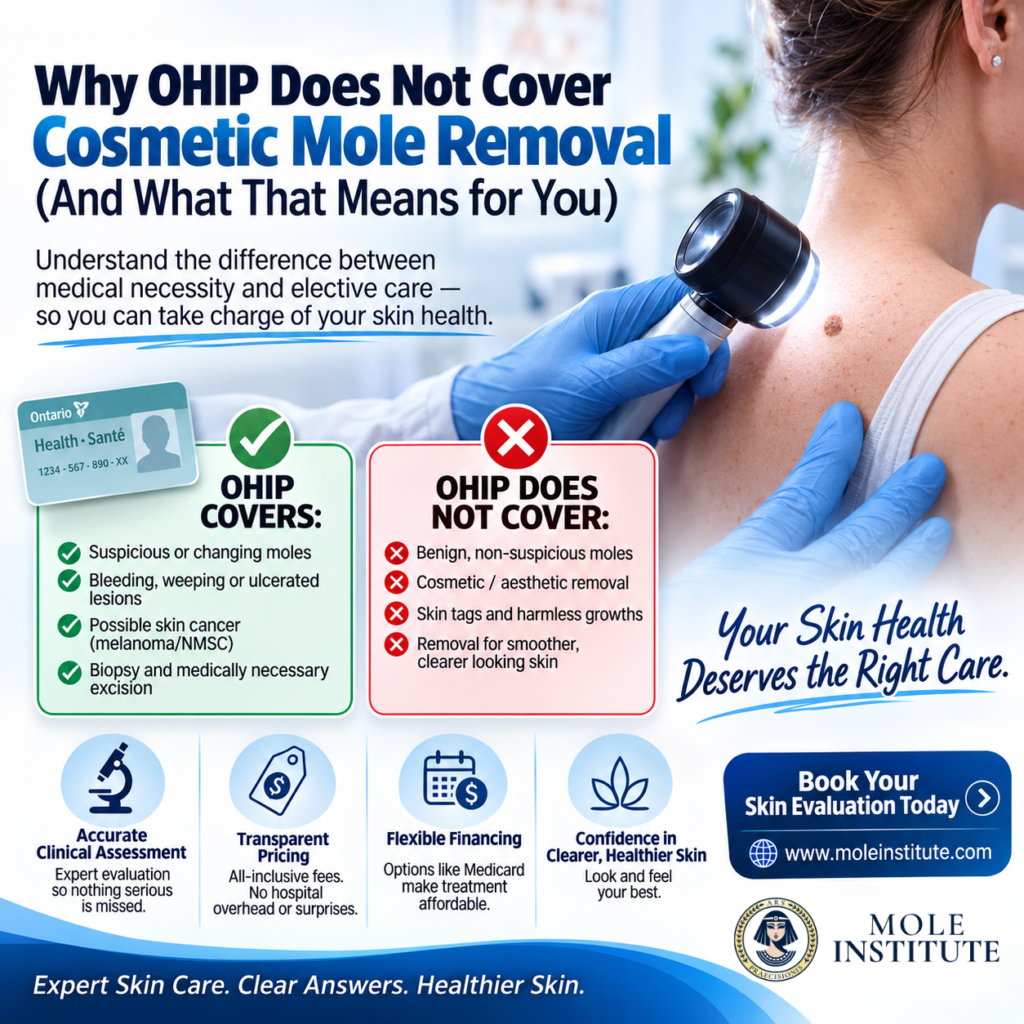
Many Ontarians notice a spot on their skin, visit a doctor expecting their red-and-white provincial health card to handle everything, and leave feeling surprised by out-of-pocket costs. When it comes to benign skin growths, navigating the healthcare system often feels frustratingly opaque, leaving patients unsure what is medically necessary and what falls strictly into elective care.
Understanding why OHIP does not cover cosmetic mole removal is the first step toward taking ownership of your personal skin wellness. Once you understand how the provincial system differentiates between medical vigilance and aesthetic procedures, budgeting for your care becomes straightforward, predictable, and stress-free.
At Mole Institute, we believe your skin health deserves a transparent, proactive approach. Let us break down the exact money math behind public versus private removal, how clinical assessments protect your safety, and how flexible financing options keep your care entirely affordable.
Key Takeaways
- Benign, non-suspicious moles are de-listed by the Ontario Ministry of Health and classified as elective, meaning public healthcare funds cannot be billed for their removal.
- Moles presenting clinical indicators of malignancy (such as asymmetry, border irregularity, or rapid change) remain fully covered under OHIP for biopsy and excision.
- A specialized clinical assessment ensures that a dangerous lesion is never mistakenly excised as a simple cosmetic nuisance.
- Transparent clinic pricing eliminates unexpected hospital overhead and facility fees by giving you an all-inclusive rate upfront.
- Patient financing through programs like Medicard enables affordable monthly payments so you never have to delay taking care of unwanted skin growths.
The Evolution of Ontario Health Billing for Skin Lesions
To understand the current policy, it helps to look at how public healthcare spending evolved across Ontario. Decades ago, the provincial billing schedule permitted physicians to remove almost any skin lesion under public coverage. However, as healthcare budgets tightened and demands on surgical resources surged, the provincial government restructured the Schedule of Benefits.
The de-listing of benign skin lesion removals reclassified minor aesthetic interventions as non-essential cosmetic procedures. Under the governing framework established by the Ontario Ministry of Health, public funds are strictly reserved for medically necessary treatments: conditions causing physical disease, chronic infection, severe functional impairment, or confirmed cancer.
If a mole sits quietly along your collarbone or jawline, causes no biological harm, and exhibits zero clinical red flags, the province considers its removal entirely elective. In short, OHIP covers life-preserving and reconstructive interventions, while aesthetic refinement remains the personal financial responsibility of the patient.
Medical Necessity vs. Cosmetic Choice: Where the Line Is Drawn
Drawing the boundary between medical necessity and cosmetic preference requires rigorous clinical expertise. Many individuals consider a raised spot annoying because it snags on a sports jersey or catches on a razor. However, physical friction or minor rubbing rarely qualifies as a medical necessity under provincial guidelines.
According to screening guidance published by the Canadian Cancer Society, true medical concern hinges on indicators of malignancy, specifically the risk of melanoma or non-melanoma skin cancer. A family physician or specialized provider will evaluate your skin against the ABCDE criteria:
- Asymmetry: One half of the spot does not match the other.
- Border: Edges are irregular, ragged, notched, or blurred.
- Colour: Pigment is uneven, with shades of brown, black, pink, or white.
- Diameter: The lesion measures greater than 6 mm across, though melanomas can be smaller.
- Evolving: The spot is visibly changing in size, shape, surface texture, or symptomatic sensation.
If a lesion shows these atypical signs, the diagnostic process and subsequent surgical excision are covered by provincial healthcare. For data on how vital early evaluation is, the surveillance updates from the Public Health Agency of Canada consistently show that catching skin anomalies early drastically reduces long-term intervention costs and improves outcomes.
Detection Over Pure Observation: The Role of Clinical Mapping
Before you even think about the financial aspect of removing a growth, accurate clinical evaluation must come first. Many people assume skin health is just a quick peek in the bathroom mirror every few months. In reality, a casual glance cannot detect the cellular shifts occurring beneath the epidermis.
Think of it like regular vehicle diagnostics: you do not wait for the check engine light to flash red while cruising down the highway before checking what is going on under the hood. Proactive preventative monitoring catches subtle wear and tear before it results in a major breakdown.
By utilizing dermoscopy alongside specialized skin monitoring, trained practitioners evaluate pigment networks at a micro-level. Professional mapping documents your lesions in detail. This ensures that when a spot is slated for removal, it has already been thoroughly evaluated.
If a lesion poses an active risk, it enters the insured medical stream. If it is verified as completely harmless, you can proceed with elective removal knowing your general health is fully protected. Guidance from the Canadian Dermatology Association highlights regular professional skin examinations as the cornerstone of effective early intervention.
The Real Money Math: Public Waitlists vs. Transparent Private Care
When patients learn that an unwanted, benign mole will not be paid for by the province, their second surprise is often how murky cosmetic quotes can be in hospital-adjacent settings. Private hospital clinics often bill an initial consultation fee, an operating facility fee, separate tray costs, and physician procedure fees. The final invoice can feel like reading a confusing repair bill full of mystery line items.
By contrast, choosing a specialized private provider gives you complete predictability. At Mole Institute, our mole removal services are designed around upfront, all-inclusive pricing without surprise add-ons.
Here is how the financial and practical comparison looks for patients evaluating their options:
- Direct Access: Public specialist referrals often require 6 to 12 months of waiting, only for a patient to be told at the appointment that the benign lesion cannot be treated under OHIP. Private clinics offer immediate consultation and swift elective care.
- All-Inclusive Fees: A dedicated clinic bundles procedure costs, surgical materials, and follow-up guidance into one clear fee.
- Zero Referral Red Tape: You do not need to spend hours waiting in walk-in clinics across Southern Ontario just to request an elective referral letter.
- Aesthetic Focus: When dealing with benign lesions on visible areas like the face, neck, or arms, private removal techniques prioritize fine scar management and skin contours.
Accessible Healthcare Financing with Medicard
A common concern among patients is balancing elective self-care with household monthly budgets. If you have several unwanted lesions or simply prefer not to allocate a lump sum out of pocket right away, healthcare financing fills the gap cleanly.
We partner with established Canadian patient financing providers like Medicard by iFinance Canada to provide flexible, low-stress payment plans.
Financing transforms your procedure from a single out-of-pocket hit into an approachable monthly investment, roughly equivalent to your weekly coffee run or a minor routine car maintenance budget. This structure empowers you to pursue clear skin, remove physical annoyances, and regain your confidence without disrupting your household financial plans.
Protecting Communities Across Southern Ontario
Access to dedicated skin health services should not require traveling across the province. Mole Institute serves individuals and families throughout the Greater Golden Horseshoe who want reliable skin surveillance and straightforward cosmetic solutions.
Whether you reside locally in the historic core of Hamilton or commute from neighboring lakeside communities like Burlington and Oakville, swift clinical access is readily available. We frequently welcome patients driving east along Highway 403 from Brantford, as well as residents from nearby Stoney Creek. Our central location ensures that dependable, transparent care remains just a brief drive away for regional communities.
Global cancer surveillance reports from the World Health Organization emphasize that accessible, community-based care centers remain the single most effective barrier against advancing skin disease. By providing rapid assessments and clear financial options close to home, we help keep our surrounding communities safe and informed.
Frequently Asked Questions
Can my family doctor write a note saying my mole causes pain so OHIP covers its removal? No. Ontario physicians must follow strict Ministry of Health billing guidelines. A family doctor cannot bill OHIP for lesion removal unless objective clinical indicators of disease, infection, functional restriction, or suspected malignancy are present. Falsifying clinical necessity for cosmetic convenience constitutes billing non-compliance.
Will my private workplace health insurance cover cosmetic mole removal? Standard extended health benefit plans rarely cover purely aesthetic lesion removals. However, if your employer provides a Health Spending Account (HSA) or Cost-Plus arrangement, those funds can often be allocated toward elective physician-led procedures. It is best to check your plan provisions directly with your benefits administrator.
What happens if a mole removed for cosmetic reasons turns out to be suspicious? Even during elective procedures, tissue integrity and patient safety come first. If a practitioner removes an atypical growth or suspects irregular cellular architecture upon closer view, the specimen is immediately transferred to a pathology laboratory for formal histopathological assessment, which is processed through standard medical channels.
Is it cheaper to have cosmetic mole removal done at a day surgery hospital? Usually no. Hospital surgical day centers or ambulatory facilities often charge separate facility fees, nursing support fees, and equipment charges on top of professional surgical billings for non-insured services. A focused private minor-surgery clinic typically provides much lower, all-inclusive pricing.
Does Medicard financing affect my everyday personal credit line? Medicard acts as an independent medical installment loan. Once established, it features fixed regular repayments that do not tie up your revolving daily credit cards or bank lines of credit, keeping your everyday cash flow smooth and uninterrupted.
Taking Control of Your Skin Health Today
Navigating provincial health coverage does not have to be an exercise in guesswork. While OHIP prioritizes life-threatening pathology, your comfort, appearance, and confidence matter too.
Knowing upfront why OHIP does not cover cosmetic mole removal allows you to make clear, empowered decisions about your personal well-being. With transparent pricing, specialized preventative skin checks, and accessible financing options, achieving healthy skin is entirely within your reach.
Reach out to Mole Institute to schedule your thorough clinical skin assessment, review your personal risk factors, and explore our personalized care plans today.